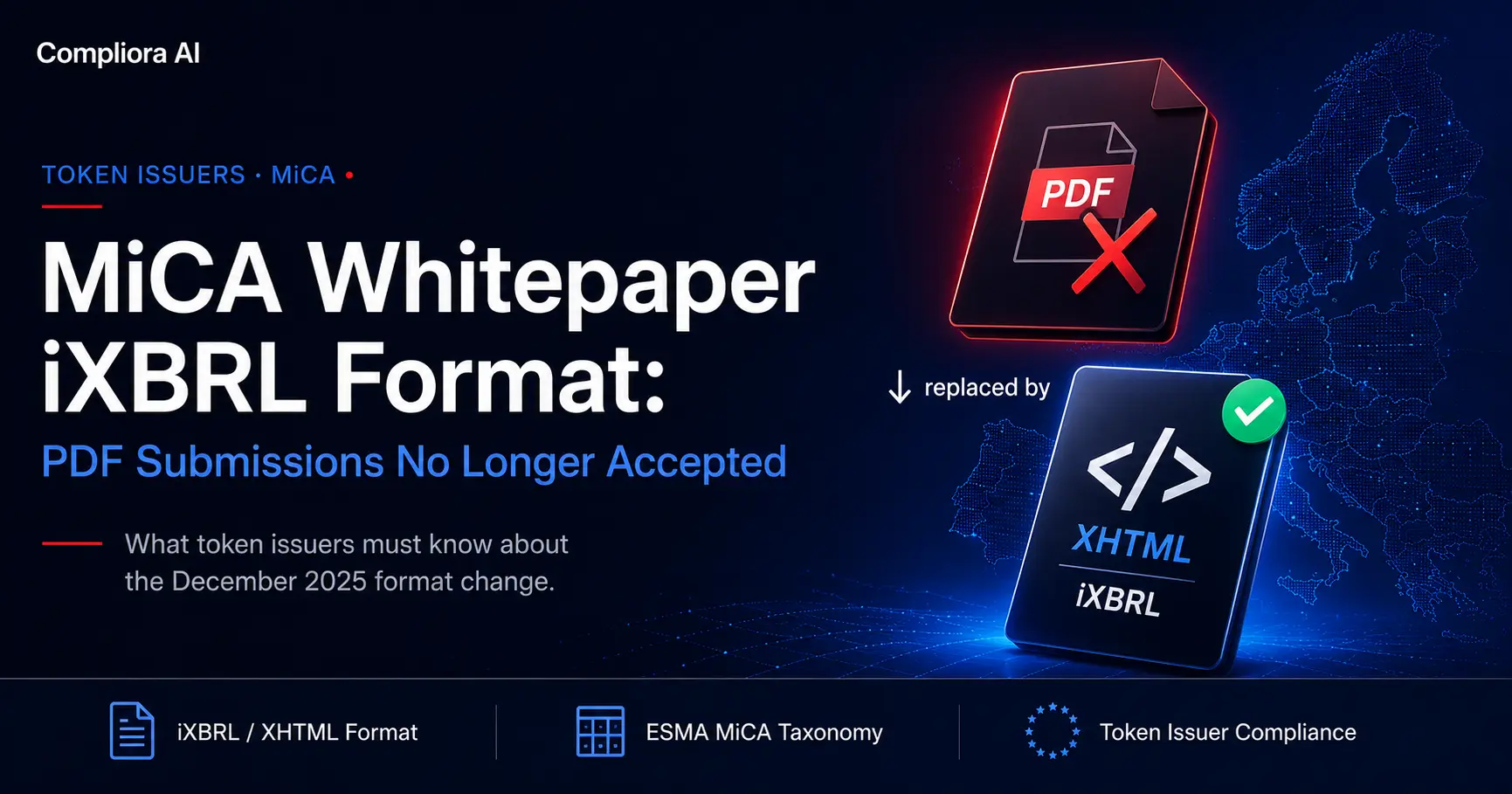
What changed on 23 December 2025
Before December 2025, most MiCA whitepapers were submitted as PDF documents — the same format founders use for pitch decks and investor materials. That approach is now non-compliant.
Commission Implementing Regulation (EU) 2024/2984, published on 29 November 2024, introduced mandatory technical standards for the form, format, and templates of MiCA crypto-asset white papers. The regulation required all white papers notified or submitted from 23 December 2025 onwards to use Inline XBRL (iXBRL) format, submitted as a single XHTML file.
ESMA published the associated MiCA XBRL taxonomy on 5 August 2025, giving issuers approximately four months to prepare. As of writing, compliance rates remain low — one analysis found that only 1% of whitepapers in the ESMA interim register were in HTML format, while 38% were still PDFs.
If you submitted a PDF whitepaper before 23 December 2025: it was compliant at the time. However, any material update or new submission must now use iXBRL format. The old PDF does not automatically need to be converted — but you cannot resubmit or update it in PDF form.
What is iXBRL and why does it matter
XBRL (eXtensible Business Reporting Language) is a structured data standard used across EU financial regulation — most notably in ESEF, the reporting format required for listed companies' annual financial reports. iXBRL (Inline XBRL) extends this by embedding machine-readable tags within a document that still reads normally to a human.
The practical result: an iXBRL whitepaper is simultaneously a human-readable document and a structured dataset that regulators can automatically extract, compare, and validate across thousands of submissions.
For ESMA and national competent authorities, this means they can:
- Run automated consistency checks on every submitted whitepaper
- Detect missing mandatory disclosures immediately
- Compare token risk disclosures across projects at scale
- Feed whitepaper data directly into the public ESMA register
For token issuers, it means that a technically correct document with accurate content can still fail validation if the iXBRL tags are incorrectly mapped to the ESMA taxonomy. Substantive accuracy and technical compliance are separate requirements.
Key rule: a submission may be flagged or rejected at a technical level even if the underlying disclosures are accurate. Conversely, passing technical validation does not guarantee legal compliance with MiCA's substantive requirements. Both must be satisfied independently.
Who needs an iXBRL whitepaper
The iXBRL format requirement applies to anyone who must prepare a MiCA white paper — which is broader than many founders assume.
| Entity type | Whitepaper obligation | iXBRL required? |
|---|---|---|
| Issuers of utility tokens (OTHR) offering to the public | Article 4 MiCA — mandatory before public offer | Yes |
| Issuers of ARTs (asset-referenced tokens) | Article 16-47 MiCA — mandatory, NCA approval required | Yes |
| Issuers of EMTs (e-money tokens) | Title IV MiCA — mandatory, credit institution or EMI required | Yes |
| CASPs operating trading platforms (for listed assets) | Article 5 MiCA — must ensure whitepaper exists before listing | Yes, if CASP initiates listing |
| Projects offering to fewer than 150 persons per Member State | Exempt from whitepaper obligation | Not required |
| Offers below €1 million over 12 months | Exempt from whitepaper obligation | Not required |
| Free token distributions with no conditions | Exempt from whitepaper obligation | Not required |
One frequently misunderstood point: Kraken's public listing requirements confirm that any project seeking EU listing must now produce a whitepaper in iXBRL format and submit it to an NCA at least 20 business days before the target listing date. This means token teams planning exchange listings must build iXBRL preparation into their timeline well in advance.
The ESMA MiCA taxonomy explained
The ESMA MiCA taxonomy is the structured tagging framework that must be applied when preparing the iXBRL whitepaper. It defines the specific data elements — called taxonomy elements — that correspond to each required disclosure in the whitepaper.
The taxonomy is available at esma.europa.eu/document/mica-taxonomy-2025. It covers three token types, each with its own set of mandatory disclosure fields:
- OTHR — crypto-assets other than ARTs or EMTs (utility tokens, governance tokens, most project tokens)
- ART — asset-referenced tokens (basket-backed stablecoins)
- EMT — e-money tokens (single-currency stablecoins like euro stablecoins)
Each taxonomy element has a specific label and identifier that must match the corresponding field in the whitepaper. A common practical problem: the element names in the taxonomy do not always match the field names used in the Implementing Technical Standard templates. Issuers must map their disclosures to the correct taxonomy element, not to the nearest-sounding label.
The taxonomy also incorporates automated validation rules that check:
- Completeness — all mandatory fields are present
- Consistency — data fields do not contradict each other
- Identification — a valid Legal Entity Identifier (LEI) is linked and verified
LEI requirement: from 23 December 2025, all MiCA whitepapers must be linked to a valid Legal Entity Identifier (LEI), which is subject to automated verification. If your entity does not have an LEI, obtaining one typically takes 3-5 business days and costs €65-130 depending on the LEI issuer. This must be factored into your whitepaper timeline.
How to prepare a compliant iXBRL whitepaper
There are three main pathways for token issuers preparing an iXBRL whitepaper:
Option 1 — ESMA's free Excel-based showcase templates
ESMA published three Excel-based showcase files (SCWP) — one for each token type — that can generate basic iXBRL output. These are available at the ESMA MiCA taxonomy page and were last updated in December 2025.
The showcase templates are useful for understanding the structure and experimenting with the format. However, ESMA explicitly notes that the output "needs validation and remains under the full responsibility of the preparer." The templates do not validate against the full ESMA taxonomy and are not production-ready for submission without additional technical review.
Best for: technical teams that want to understand the format before engaging external support.
Option 2 — Commercial iXBRL tooling
Specialist software solutions like DataTracks Rainbow are designed specifically to generate ESMA-compliant XHTML/iXBRL documents. These tools automatically load the latest MiCA taxonomy, apply the correct tags, and provide validation before submission.
Best for: teams with in-house legal and compliance capacity who need technical tooling but not external legal advice.
Option 3 — End-to-end specialist support
Law firms and specialist compliance providers offer complete whitepaper preparation services — from token classification through drafting, iXBRL formatting, and NCA submission. This is the most common approach for first-time submissions where regulatory risk is high.
Best for: projects without prior MiCA whitepaper experience, ART and EMT issuers (where NCA approval is required), and any project planning an EU exchange listing.
The step-by-step process for a compliant submission looks like this:
- Classify your token — determine whether you are issuing an OTHR, ART, or EMT. This determines which taxonomy and which templates apply. A misclassification at this stage invalidates everything downstream.
- Obtain an LEI — apply through an accredited LEI issuer if you do not already have one. Allow 3-5 business days.
- Draft the whitepaper content — cover all mandatory disclosures under Article 6 MiCA and the Implementing Regulation templates for your token type. The document must be fair, clear, and not misleading.
- Map disclosures to taxonomy elements — each disclosure must be tagged with the correct ESMA taxonomy element identifier. This is where most technical errors occur.
- Generate and validate the XHTML/iXBRL file — the final submission is a single XHTML file with embedded iXBRL tags. Validate against the taxonomy using Arelle (open-source) or your chosen commercial tool.
- Submit to the NCA — notify your home Member State NCA at least 20 business days before your intended public offer or exchange listing. The NCA then forwards the whitepaper to ESMA for publication on the interim register.
Common mistakes to avoid
Based on the current state of ESMA register submissions, the most frequent compliance failures are:
- Submitting PDF-only documents. As of May 2026, a significant portion of projects still believe PDF submission is acceptable. It is not, for any whitepaper submitted or notified after 23 December 2025.
- Using the wrong token classification. The taxonomy and templates differ substantially between OTHR, ART, and EMT. Applying OTHR templates to what is substantively an ART is both technically and legally non-compliant.
- Taxonomy element mismatches. Tagging a disclosure with a taxonomy element that does not precisely correspond to that field will trigger validation failures — even if the content itself is accurate.
- Missing or invalid LEI. The LEI must be active and verifiable at the time of submission. An expired or incorrectly registered LEI causes automatic rejection.
- Not accounting for NCA submission timelines. Many NCAs require 20 business days (approximately one calendar month) between whitepaper submission and the intended offer date. Planning backwards from a launch date without factoring in this window is a common planning error.
- Assuming technical validation equals legal compliance. A whitepaper that passes iXBRL validation may still contain substantively non-compliant disclosures — for example, incomplete risk factors or misleading projections.
Not sure if your project needs a MiCA whitepaper?
Before investing in whitepaper preparation, it helps to confirm whether MiCA applies to your project at all — and if so, under which framework. Our AI-powered assessment covers MiCA, MiFID II, PSD2, and AIFMD in minutes.
Start your assessment →Frequently asked questions
Is a PDF whitepaper still accepted under MiCA?
No. From 23 December 2025, PDF-only submissions no longer meet MiCA's technical requirements under Commission Implementing Regulation (EU) 2024/2984. All crypto-asset white papers must be submitted as a single XHTML file with embedded iXBRL tags.
What is the ESMA MiCA taxonomy?
The ESMA MiCA taxonomy is the structured tagging framework published by ESMA on 5 August 2025 that must be applied when preparing iXBRL whitepapers. It defines the specific data elements — one for each required disclosure — that must be used when tagging whitepaper content. Submissions tagged with incorrect elements fail automated validation.
Does the iXBRL requirement apply to existing whitepapers?
Not retroactively — whitepapers submitted before 23 December 2025 in PDF format were compliant at the time. However, any material update or new submission after that date must use iXBRL format. You cannot resubmit or update an old whitepaper in PDF form.
What tools can I use to create an iXBRL MiCA whitepaper?
ESMA provides free Excel-based showcase templates (SCWP files) for OTHR, ART, and EMT tokens — useful for understanding the format but not production-ready without additional validation. Commercial tools like DataTracks Rainbow automate taxonomy loading and validation. Specialist law firms and compliance providers offer end-to-end whitepaper preparation including iXBRL formatting.
How long does it take to prepare an iXBRL whitepaper?
The whitepaper content itself — drafting, review, legal sign-off — typically takes 4-8 weeks depending on project complexity. The iXBRL conversion and validation adds 1-2 weeks on top. NCA submission must happen at least 20 business days before your intended offer date. Total timeline from starting the process to being cleared for a public offer: typically 8-14 weeks.
Can I use Arelle to validate my iXBRL whitepaper?
Arelle is an open-source tool that can verify document compliance with xHTML/iXBRL standards and is useful for initial technical validation. However, ESMA guidelines require the use of the MiCA-specific iXBRL taxonomy, which is not validated by any open-source tool at the time of writing. Commercial tools or specialist providers are needed for full taxonomy validation.