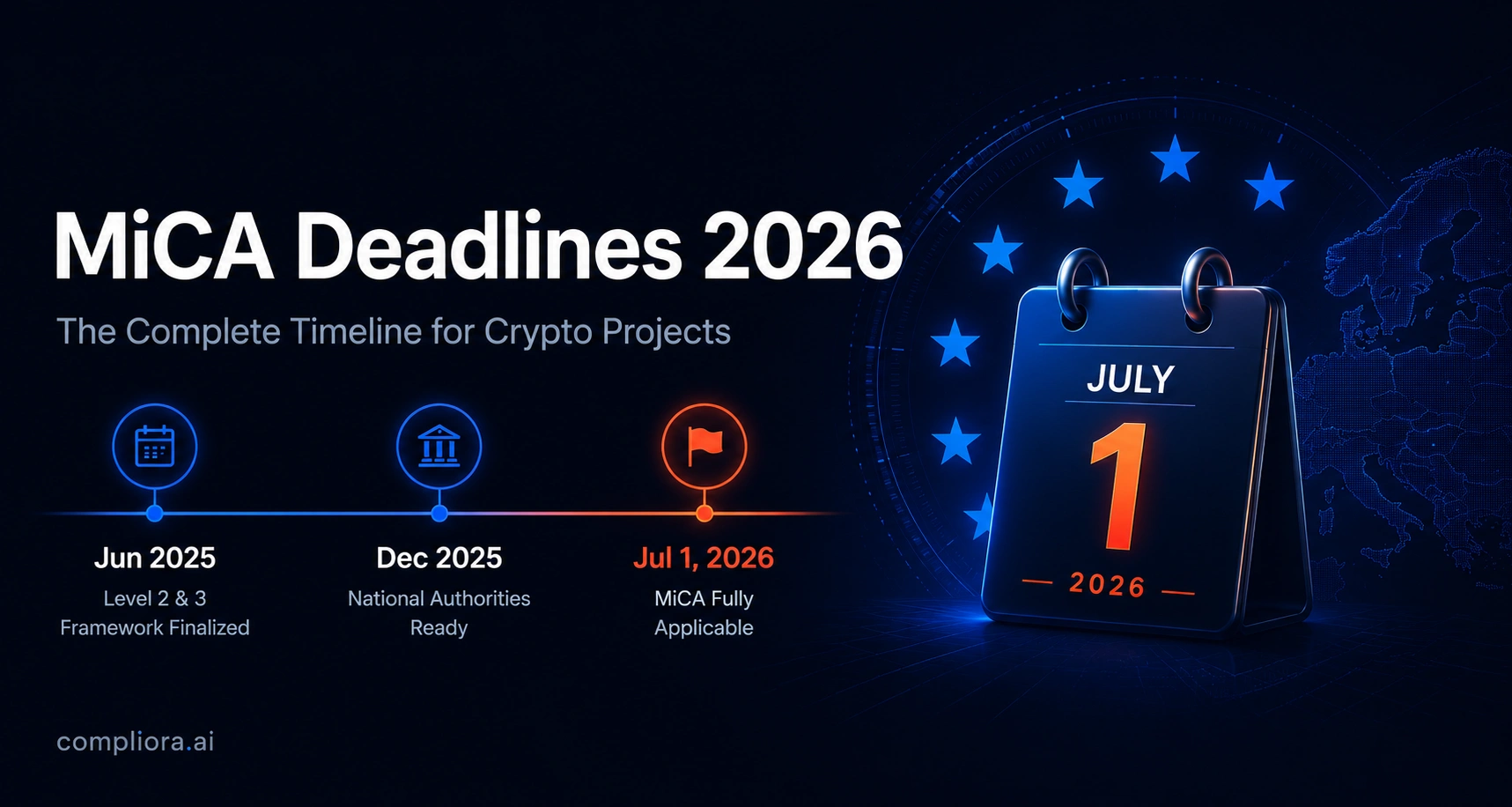
Key MiCA dates at a glance
MiCA rolled out in phases. Understanding where each deadline fits helps you assess which rules currently apply to your project.
| Date | What happened | Who it affects |
|---|---|---|
| June 30, 2024 | MiCA Title III and IV applied — stablecoin rules for ARTs and EMTs came into force | Stablecoin issuers |
| December 30, 2024 | Full MiCA framework for CASPs applied. Grandfathering transitional period began for existing providers | All CASPs, token issuers |
| June 30, 2025 | Transitional period closed in NL, Latvia, Hungary, Slovenia, Finland (6-month window) | Existing CASPs in those countries |
| September 30, 2025 | Transitional period closed in Sweden | Existing CASPs in Sweden |
| December 31, 2025 | Transitional period closed in Germany, Austria, Ireland, Lithuania, Slovakia | Existing CASPs in those countries |
| January 1, 2026 | DAC8 reporting requirements began — exchanges must report EU user transaction data to tax authorities | All CASPs with EU users |
| March 2026 | Dual licensing requirement started — EMT custody and transfer may require both MiCA and PSD2 authorisation | Stablecoin custodians and transfer services |
| July 1, 2026 | Absolute EU-wide deadline. All remaining transitional periods close. No CASP may operate without MiCA authorisation | All CASPs across all 27 EU member states |
50 days remaining. As of May 13, 2026, there are approximately 50 days until the July 1 hard cutoff. ESMA has stated explicitly that no further extensions will be granted. Firms that have not yet applied for authorisation are unlikely to receive a decision before the deadline.
What July 1, 2026 actually means
The July 1 deadline operates on two levels depending on whether your project was operating before December 30, 2024 (existing CASP) or after it (new project).
For existing CASPs covered by grandfathering
If your project was providing crypto-asset services legally under a national regime before December 30, 2024, you were eligible for the Article 143(3) MiCA grandfathering — the transitional period that let you continue operating under old national rules while applying for MiCA authorisation.
That transitional window closes at the latest on July 1, 2026. But — critically — it also closes the moment your MiCA authorisation application is granted or refused. If your application was rejected in April 2026, your grandfathering ended in April 2026. You cannot continue operating while appealing.
ESMA's April 2026 statement made the enforcement expectation explicit: by July 1, any unauthorised CASP must have completed an orderly wind-down of its EU client operations. This includes notifying clients, migrating them to authorised providers, and ceasing to solicit EU customers.
For new projects started after December 30, 2024
Grandfathering does not apply. If your project launched after December 30, 2024, you have been operating in a regime where MiCA authorisation was required from day one to legally provide regulated crypto-asset services in the EU.
July 1, 2026 changes nothing for you specifically — your obligation to hold MiCA authorisation before operating already exists. What changes is enforcement intensity: after July 1, NCAs across the EU are expected to actively pursue non-compliant operators.
Not sure whether MiCA applies to your project at all? The regulation covers crypto-asset service providers and token issuers — but the scope depends on what your project actually does. A DeFi protocol with no intermediary, for instance, may fall outside MiCA entirely. See our article on whether MiCA applies to your project for the full framework.
New projects: what the deadline means in practice
For founders building a new crypto project in 2026, the relevant question is not "when does my grandfathering expire" — it is "do I need MiCA authorisation to launch, and how long does it take to get one?"
The CASP authorisation process typically takes three to six months from submission of a complete application, assuming the NCA processes it without requests for additional information. Given that July 1 is approximately 50 days away, any project that has not already submitted a complete application has almost no realistic path to receiving authorisation before the deadline.
The practical options for new projects are:
- Launch in a non-EU market first while pursuing CASP authorisation, then expand to the EU once licensed
- Structure the product to fall outside MiCA scope — for example, by eliminating the intermediary role that triggers CASP classification
- Partner with an authorised CASP that can provide the regulated service layer while you build the product layer
- Apply now and plan for a post-July 1 EU launch once authorisation is received
The right path depends on what your project actually does, which token categories it involves, and which CASP service types it provides. This is precisely what a preliminary MiCA assessment is designed to clarify.
Country-by-country deadline overview
One of the most confusing aspects of MiCA implementation is that the grandfathering period was not uniform across the EU. Member states had discretion to apply transitional windows of 6, 12, or 18 months. Several chose shorter windows, meaning their deadlines already passed.
| Country | Transitional period | Deadline | Status |
|---|---|---|---|
| Netherlands | 6 months | June 30, 2025 | Closed |
| Latvia | 6 months | June 30, 2025 | Closed |
| Hungary | 6 months | June 30, 2025 | Closed |
| Slovenia | 6 months | June 30, 2025 | Closed |
| Finland | 6 months | June 30, 2025 | Closed |
| Poland | 6 months (registered VASPs only) | June 30, 2025 | Closed |
| Sweden | 9 months | September 30, 2025 | Closed |
| Germany | 12 months | December 31, 2025 | Closed |
| Austria | 12 months | December 31, 2025 | Closed |
| Ireland | 12 months | December 31, 2025 | Closed |
| Lithuania | 12 months (extended from 5 months) | December 31, 2025 | Closed |
| Slovakia | 12 months | December 31, 2025 | Closed |
| Italy | 18 months (application submitted by Dec 30, 2025) | July 1, 2026 | Closing |
| Spain | 18 months (extended from 12 months in Dec 2025) | June 30, 2026 | Closing |
| France | 18 months | July 1, 2026 | Closing |
| Malta | 18 months | July 1, 2026 | Closing |
| Luxembourg | 18 months | July 1, 2026 | Closing |
| Estonia | 18 months | July 1, 2026 | Closing |
| Czech Republic | 18 months | July 1, 2026 | Closing |
The practical implication: if your project serves users in Germany and the Netherlands, your transitional period for those markets expired at the end of 2025 and mid-2025 respectively — even if your registered entity is in Malta where the window runs until July 1. MiCA passporting rights during the transitional period only apply once you hold actual MiCA authorisation, not while operating under grandfathering in a different member state.
What happens if you miss the July 1 deadline
ESMA and national competent authorities have been explicit about enforcement expectations post-July 1. The consequences of operating without MiCA authorisation after the deadline include:
- Fines up to €5 million or 5% of annual turnover — whichever is higher
- Cease-and-desist orders requiring immediate suspension of EU operations
- Bans on operating in the EU — potentially permanent
- License revocation for any existing national authorisations
- Criminal liability for executives — France's AMF has specifically warned that operating post-deadline without a licence can trigger prison time
- Forced client wind-down — NCAs can require compulsory migration of client assets and accounts to authorised providers
ESMA has also stated that it expects NCAs to actively enforce against non-compliant operators after July 1, and that it will coordinate cross-border enforcement for firms operating across multiple member states.
Approximately 18% of European crypto platforms have chosen to exit the EU market entirely rather than pursue MiCA authorisation, according to research cited by Zitadelle AG. If this is the path your project is considering, it requires its own careful planning — particularly around client notification, asset migration, and avoiding reverse solicitation violations.
What to do before July 1
If your project provides crypto-asset services in the EU and does not hold MiCA authorisation, the immediate priority is understanding your legal position. The questions that matter most right now:
- Does MiCA apply to your project at all? Not every crypto project is a CASP. DeFi protocols, certain NFT platforms, and projects that do not intermediate transactions may fall outside scope entirely.
- Which CASP service categories does your project trigger? MiCA defines nine distinct service types, from custody to exchange to portfolio management. Your authorisation obligations depend on which ones apply.
- Are you covered by grandfathering? Only projects operating under a national VASP/CASP regime before December 30, 2024 qualify.
- Which NCA should you apply to? Jurisdiction selection affects both the speed of processing and the ongoing compliance requirements you will face.
- What is your contingency if authorisation is not received before July 1? Do you have a wind-down plan, a market restriction strategy, or an alternative structure?
If MiCA does apply and you have not yet applied for authorisation, engaging a specialist legal team immediately is the appropriate step. A preliminary regulatory assessment can help you understand the scope of your obligations before committing to the full authorisation process.
Not sure if MiCA applies to your project?
Get a preliminary AI-powered regulatory assessment in minutes. Covers MiCA, MiFID II, PSD2, and AIFMD — with article-level legal citations and a professional PDF report.
Start your assessment →Frequently asked questions
What is the MiCA deadline for 2026?
The absolute EU-wide MiCA deadline is July 1, 2026. After this date, any crypto-asset service provider without valid MiCA authorisation must cease operations across all 27 EU member states. ESMA has confirmed no further extensions will be granted.
Does the July 1 deadline apply to new crypto projects?
New projects that launched after December 30, 2024 are not covered by grandfathering at all. They have been required to hold MiCA authorisation before providing regulated crypto-asset services in the EU since that date. July 1 does not change their obligations — it changes enforcement intensity.
Can I still apply for MiCA authorisation now?
You can submit an application, but realistically you are unlikely to receive a decision before July 1 given typical NCA processing times of three to six months. ESMA has also warned that last-minute applications will receive heightened regulatory scrutiny. This does not mean you should not apply — but it does mean July 1 will likely arrive before your authorisation does, requiring a plan for that interim period.
Do I need MiCA authorisation if I am not based in the EU?
Yes, if you provide crypto-asset services to EU customers. MiCA applies based on where services are provided, not where the provider is established. The only narrow exception is reverse solicitation — where an EU client initiates contact entirely on their own initiative. ESMA has stated this exception is narrow and must not be used as a structural workaround.
What is the difference between MiCA and CASP authorisation?
MiCA is the regulation. CASP (Crypto-Asset Service Provider) authorisation is the licence issued under MiCA that permits you to legally provide one or more of the nine defined crypto-asset services in the EU. You apply for CASP authorisation with the national competent authority of the EU member state where your entity is registered.
Which EU countries are most favourable for CASP authorisation?
This depends on your business model, timeline, and budget. Malta, Luxembourg, France, and Estonia are frequently discussed given their financial services track records and 18-month transitional windows. Germany and the Netherlands have issued the most licences to date. Each jurisdiction has different processing speeds, capital requirements, and ongoing supervision intensity. See our article on CASP licence requirements for a detailed breakdown.