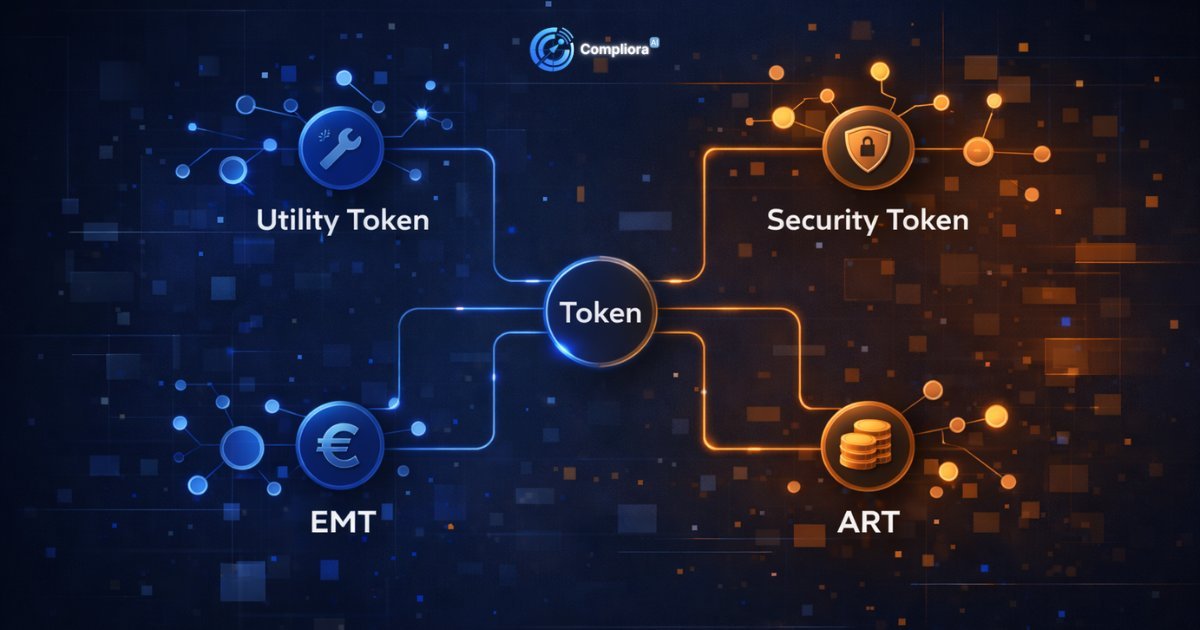
The four categories at a glance
Under EU law, a token issued in the EU falls into one of four main regulatory buckets, each with its own disclosure, authorisation, and operational regime:
- Utility token — under
Article 3(1)(9) MiCA. Regulated under Title II of MiCA. Whitepaper and notification required. - Security token — a financial instrument under MiFID II (Directive 2014/65/EU). Outside MiCA per
Article 2(4)(a). Prospectus Regulation, MiFID II, and securities laws apply. - E-money token (EMT) — under
Article 3(1)(7) MiCA. Regulated under Title IV of MiCA, with credit institution or electronic money institution authorisation required. - Asset-referenced token (ART) — under
Article 3(1)(6) MiCA. Regulated under Title III of MiCA, with a dedicated ART authorisation regime.
There is also a fifth category in practice: tokens that fall outside all the above regimes entirely. These include genuinely unique non-fungible tokens (NFTs) under Article 2(3) MiCA, fully decentralised protocols under Recital 22, and tokens that are not offered in the EU at all.
Mutually exclusive: A token can only fall into one category at a time. An EMT cannot also be a utility token. A security token cannot also be an ART. The classification determines one regulatory path — not several at once.
Utility token — Article 3(1)(9) MiCA
The utility token is the simplest and most common category for Web3 projects.
Legal definition
'Utility token' means a type of crypto-asset that is only intended to provide access to a good or a service supplied by its issuer.
— Article 3(1)(9), Regulation (EU) 2023/1114 (MiCA)
Three elements are essential:
- "Only intended" — the token's primary purpose must be utility, not speculation, profit-sharing, or investment
- "Access to a good or a service" — the token acts as a digital key or credit that unlocks something on the platform
- "Supplied by its issuer" — the utility must be within the issuer's own ecosystem, not for general payment to third parties
What utility tokens look like in practice
- Platform credits used to pay for SaaS-style services
- Network fees (e.g., "gas-like" tokens for a specific L2 chain's transactions)
- Membership or access tokens for gated content or features
- In-game currencies that only work within the issuer's game
- Tokens granting voting rights on platform parameters (where the votes don't confer economic benefits)
Regulatory requirements — Title II MiCA
Utility tokens are regulated under Title II MiCA (Articles 4-15). Key obligations:
- Whitepaper — a MiCA-compliant whitepaper with content specified in
Annex I MiCA. Covers the project, the token, rights attached, risk factors, and sustainability disclosures. - Notification — the whitepaper must be notified to the home NCA at least 20 working days before publication under
Article 8 MiCA. - Marketing communications — must be fair, clear, not misleading, and consistent with the whitepaper (Article 7 MiCA).
- Right of withdrawal — retail holders have a 14-day right of withdrawal for purchases from the offeror under
Article 13 MiCA. - Issuer liability — civil liability for material omissions or misstatements in the whitepaper.
Important exemption: Under Article 4(3)(c) MiCA, Title II does not apply to utility tokens that provide access to a good or service that exists or is already in operation. This is an important carve-out for established platforms launching native tokens — but it does not exempt you from the general MiCA crypto-asset rules, only from the Title II whitepaper regime.
Security token — MiFID II financial instrument
A "security token" is not a MiCA category — it's a shorthand for a crypto-asset that qualifies as a financial instrument under MiFID II. The EU legal term is simply "financial instrument" as defined in Article 4(1)(15) of Directive 2014/65/EU (MiFID II), referring to the instruments listed in Section C of Annex I to MiFID II.
Under Article 2(4)(a) MiCA, any crypto-asset that qualifies as a MiFID II financial instrument is expressly excluded from MiCA's scope. See our dedicated analysis in MiCA vs MiFID II: Which Applies to Your Token.
When a token becomes a security
The most common pathway for a token to become a security is qualification as a transferable security under Article 4(1)(44) MiFID II. This requires three cumulative criteria: classes of securities, negotiable on the capital market, not an instrument of payment.
Token features that push toward security classification:
- Profit-sharing or revenue entitlement — rights to distributions from the issuer
- Redemption rights against the issuer — the ability to exchange the token for cash or assets held by the issuer
- Voting rights with economic consequences — governance rights that affect treasury, token issuance, or distributions
- Claims on the issuer's assets — including in liquidation
- Marketing focused on investment returns — promoting the token as a means of capital appreciation
Regulatory regime for security tokens
Security tokens are fully subject to EU securities law:
- Prospectus under the Prospectus Regulation (
Regulation (EU) 2017/1129) for public offerings above relevant thresholds - Investment firm authorisation for service providers (brokers, advisors, portfolio managers)
- Market Abuse Regulation (
Regulation (EU) No 596/2014) — insider dealing prohibitions, market manipulation rules, disclosure obligations - MiFIR transparency for trading venues
- Client asset rules under MiFID II for intermediaries
Unsure which category your token falls into?
Compliora AI analyses your token against all four EU frameworks simultaneously and identifies exactly which applies. Professional legal report with citations.
Start Assessment →E-money token (EMT) — Article 3(1)(7) MiCA
E-money tokens are the MiCA category for single-currency stablecoins.
Legal definition
'Electronic money token' or 'e-money token' means a type of crypto-asset that purports to maintain a stable value by referencing the value of one official currency.
— Article 3(1)(7), Regulation (EU) 2023/1114 (MiCA)
The three elements:
- "Purports to maintain a stable value" — the design intent is stability, regardless of how well that stability is achieved in practice
- "Referencing the value of one official currency" — a single fiat currency like EUR, USD, or GBP, issued by a central bank or monetary authority
- Crypto-asset — tokenised on a DLT or similar technology
EMTs are the most common example of "stablecoins" — USDT, USDC, and EURC are all EMTs under MiCA. A EUR-pegged stablecoin issued by an EU entity is an EMT. A USD-pegged stablecoin offered to EU users is also an EMT.
Regulatory regime — Title IV MiCA
EMTs are subject to Title IV MiCA (starting with Article 48). The core rules:
- Who can issue: Only credit institutions or electronic money institutions authorised under
Directive 2009/110/EC(the E-Money Directive, EMD) can issue EMTs. - Whitepaper — EMT whitepaper with content specified in
Annex III MiCA, notified to the NCA. - Reserve requirements — EMTs must be fully backed by high-quality liquid assets matching the referenced currency.
- Redemption at par — holders have a right to redeem their EMT at any time at par value against the issuer. No conditions, no fees beyond a reasonable processing charge.
- No interest — EMTs cannot pay interest to holders. Any yield programmes are expressly prohibited.
- Significant EMTs — EMTs crossing size thresholds become "significant" under
Article 56 MiCAand face additional EBA supervision, additional own funds, and stress testing.
EMTs began to apply earlier than the rest of MiCA: Title IV has been in force since 30 June 2024. This six-month head start for stablecoin regulation was intentional — the EU considers stablecoins the highest-risk category of crypto-assets.
Stablecoin crackdown: Throughout 2025, several major stablecoins were delisted from EU exchanges for failing to meet Title IV requirements. Binance delisted USDT pairs for EEA users in early 2025 under MiCA pressure. Projects issuing stablecoins without proper EMI or credit institution authorisation face immediate enforcement.
Asset-referenced token (ART) — Article 3(1)(6) MiCA
Asset-referenced tokens are MiCA's category for "baskets" and "multi-asset" stablecoins.
Legal definition
'Asset-referenced token' means a type of crypto-asset that is not an electronic money token and that purports to maintain a stable value by referencing another value or right or a combination thereof, including one or more official currencies.
— Article 3(1)(6), Regulation (EU) 2023/1114 (MiCA)
Key elements:
- Not an EMT — if the token references a single official currency, it's an EMT, not an ART. ART is the residual stability-seeking category.
- References another value or right, or combination — multiple currencies, commodities (gold, oil), real estate, other crypto-assets, or combinations
- Purports to maintain stability — like EMTs, the design intent is stability, not necessarily the outcome
Common ART structures
- Basket-of-currencies stablecoins (e.g., tokens backed by a weighted basket of EUR, USD, GBP, JPY)
- Commodity-backed tokens — gold tokens, oil tokens, real-estate-backed tokens
- Tokens backed by baskets of other crypto-assets (with careful analysis needed — these often become securities)
- Algorithmic stablecoins designed to track a target value (high regulatory scrutiny)
Regulatory regime — Title III MiCA
ARTs are subject to Title III MiCA (Articles 16-47). The regime is one of the most demanding in MiCA:
- ART authorisation — issuers must be authorised as ART issuers under Title III, unless they are already authorised as a credit institution
- Capital requirements — initial capital of at least EUR 350,000, or 2% of the average amount of the reserve assets, whichever is higher
- Reserve of assets — fully backed by a segregated reserve of high-quality liquid assets
- Redemption rights — holders have a right to redeem against the issuer
- No interest — like EMTs, ARTs cannot pay interest
- Whitepaper — ART whitepaper with content specified in
Annex II MiCA - Significant ARTs — ARTs over certain thresholds become "significant" under
Article 43 MiCA, facing direct EBA supervision and enhanced obligations
Title III has been in force since 30 June 2024, alongside Title IV.
Side-by-side comparison table
| Feature | Utility token | Security token | EMT | ART |
|---|---|---|---|---|
| Legal basis | Title II MiCA | MiFID II + Prospectus Reg | Title IV MiCA | Title III MiCA |
| Primary definition | Art. 3(1)(9) MiCA | Art. 4(1)(15) MiFID II | Art. 3(1)(7) MiCA | Art. 3(1)(6) MiCA |
| Authorisation | No (notification only) | Investment firm / CSD | EMI or credit institution | ART issuer authorisation |
| Whitepaper / Prospectus | Whitepaper (Annex I) | Prospectus (full EU approval) | Whitepaper (Annex III) | Whitepaper (Annex II) |
| Capital requirement | None specific | Depends on service firm | Per EMD: EUR 350,000 | EUR 350,000 or 2% reserves |
| Reserve requirement | No | No | Yes, 1:1 to currency | Yes, basket-matched |
| Redemption rights | No | Depends on terms | Yes, at par | Yes, against reserves |
| Interest allowed | N/A | Yes (coupon) | No | No |
| Applied from | 30 Dec 2024 | Long-standing | 30 June 2024 | 30 June 2024 |
Common points of confusion
"Our utility token has governance rights — is it still a utility token?"
It depends on the nature of the governance rights. Pure governance rights (voting on platform parameters without economic consequences) don't necessarily convert a utility token to a security. But if governance votes decide treasury allocation, token issuance, or distribution of revenues, the token likely becomes a financial instrument.
"Is a governance token a utility token or a security token?"
Most governance tokens with meaningful economic rights (revenue share, redemption from a treasury, rights over protocol fees) are financial instruments under MiFID II, not utility tokens under MiCA. This is one of the most common misclassifications in Web3.
"Our stablecoin is backed by BTC and ETH — is it an EMT or ART?"
Neither — strictly. EMTs reference official currencies. ARTs reference values or rights, which can include crypto-assets. A BTC/ETH-backed stablecoin is likely an ART — but the specific crypto-assets used as reference assets may themselves be securities, triggering additional complications.
"Can we split the token so part is utility and part is security?"
No. MiCA and MiFID II classify tokens holistically based on their aggregate features. You cannot split a single token into a utility component and a security component for regulatory purposes. A token with any significant security-like feature is treated as a security in its entirety.
"What about memecoins and governance-only DAOs?"
Memecoins without an identifiable issuer, utility, or financial rights are a fact-specific area. MiCA applies when there's an offeror or person seeking admission to trading. Memecoins with no issuer and no structured offering may fall outside MiCA scope entirely — though individual Member States may still assert jurisdiction under national rules.
Real-world examples by category
Clear utility tokens
- File storage platform credits — tokens used to pay for storage on the platform, not transferable for third-party services
- In-game currencies — tokens that only work within the game's economy
- API access credits — tokens that unlock API calls to a SaaS product
Clear security tokens
- Tokenised company shares — digital representation of equity with dividend rights
- Tokenised corporate bonds — debt claims with interest payments
- Tokenised real estate — where the token represents a pro-rata claim on rental income or sale proceeds
- Tokenised fund units — digital UCITS or AIF units (also subject to AIFMD / UCITS Directive)
Clear EMTs
- EURC (Circle) — EUR-pegged, 1:1 backed, authorised EMI issuer
- Native EUR stablecoins issued by EU credit institutions
- USDT/USDC when offered in the EU — classified as EMTs (with major issuers navigating MiCA authorisation)
Clear ARTs
- Gold-backed tokens — backed 1:1 by physical gold reserves
- Multi-currency basket stablecoins — tokens referencing a weighted basket of fiat currencies
- Commodity baskets — tokens tracking an index of commodities
Grey area examples
- DeFi governance tokens with fee switch — likely transferable securities if fees flow to holders
- Algorithmic stablecoins — likely ARTs, but with regulatory scepticism
- NFT collections with staking yield — staking yield may convert "NFTs" into financial instruments
- Liquidity provider tokens (LP tokens) — depends on whether the underlying pool activity is a regulated service
Decision matrix
Use this quick decision flow to identify your token's likely category:
| Question | If yes → |
|---|---|
| Does the token grant profit-sharing, revenue entitlement, or redemption against issuer's assets? | Security token (MiFID II) |
| Does the token grant governance rights with economic consequences (treasury votes, issuance votes)? | Likely security token — detailed analysis needed |
| Is the token designed to track the value of one official currency (EUR, USD, GBP)? | EMT (Title IV MiCA) |
| Is the token designed to track the value of multiple currencies, commodities, or other reference assets? | ART (Title III MiCA) |
| Is the token's only purpose to access a good or service supplied by the issuer? | Utility token (Title II MiCA) |
| Is the token genuinely unique and non-fungible (not part of a series functioning as fungible)? | NFT exemption (potentially outside MiCA) |
| None of the above clearly fits? | Likely Title II "other crypto-asset" — whitepaper required |
Many tokens in practice sit on boundaries. A governance token with both utility features and economic rights may be a utility token under MiCA or a transferable security under MiFID II, depending on the specific balance. Pure fact-pattern analysis is often required.
Get your token classified in ~10–15 minutes
Compliora AI runs your project through MiCA's three titles and MiFID II simultaneously. You get a definitive classification, regulatory roadmap, and article-level citations.
Start Assessment →