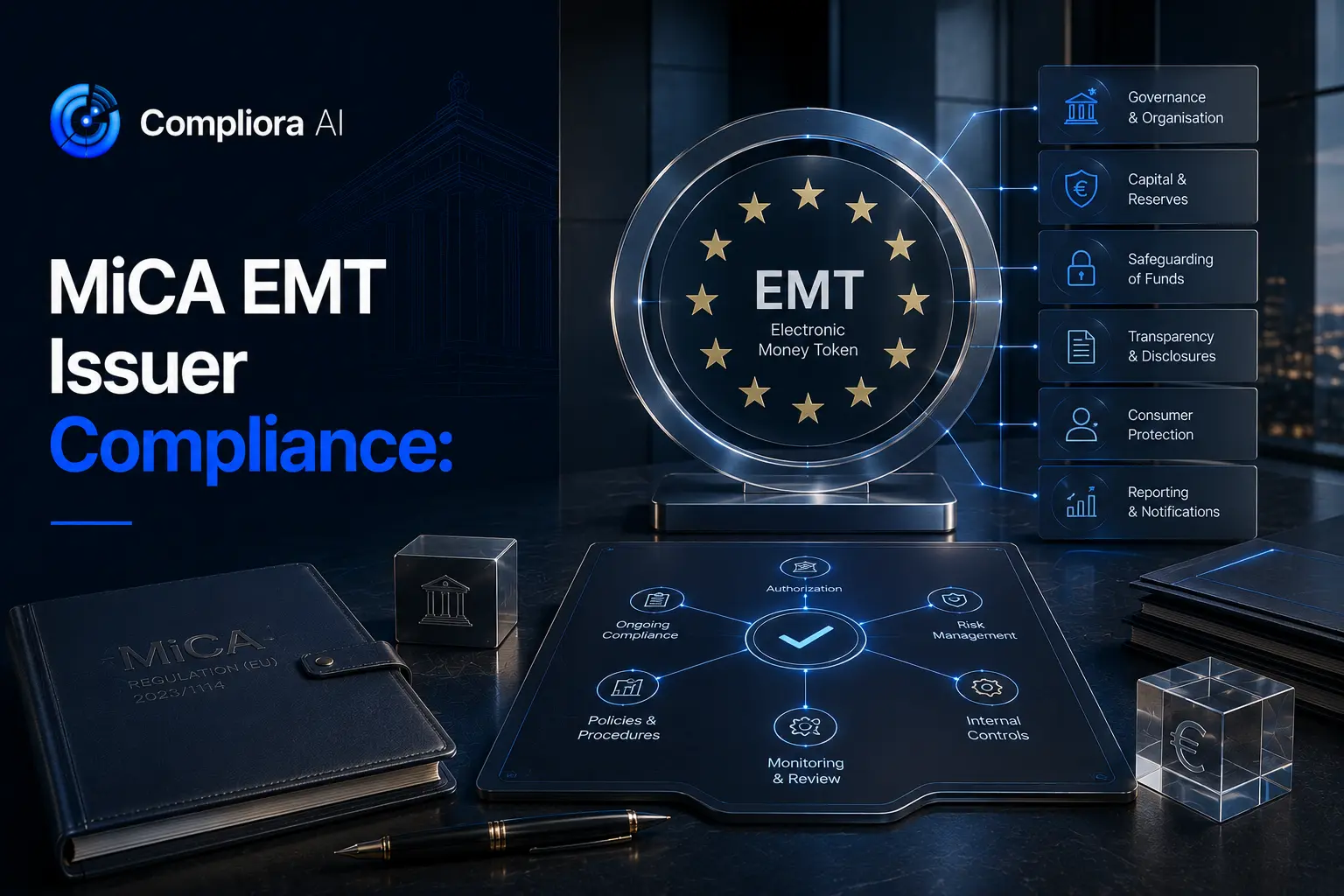
Key facts
What Qualifies as an E-Money Token Under MiCA?
Under Article 3(1)(7) of Regulation (EU) 2023/1114 (MiCA), an e-money token (EMT) is a type of crypto-asset that purports to maintain a stable value by referencing the value of one official currency. That single-currency peg is the bright-line test. A token pegged exclusively to the euro qualifies as an EMT. So does one pegged solely to the US dollar or sterling. What does not qualify is a token that references a basket of currencies — say, 60% EUR and 40% USD — because no single official currency anchors the value. That basket-referenced instrument falls instead under Title III of MiCA as an asset-referenced token (ART), governed by a materially different authorisation and reserve regime. The legal classification is determined at issuance by the reference mechanism, not by the issuer's intent or marketing language.
In practice, the distinction matters enormously for licensing. EURC (Circle's euro-pegged token) and USDC (dollar-pegged) are both EMTs under MiCA's framework — each references exactly one official currency. A hypothetical multi-currency reserve stablecoin tracking an IMF SDR-style basket would be an ART regardless of how stable its peg is. Utility tokens, by contrast, have no reference asset at all: they grant access to a service and are governed by Title II of MiCA. For a fuller breakdown of where your token sits in MiCA's taxonomy, see utility token vs security token vs EMT vs ART. The entire EMT regime — issuer requirements, reserve rules, redemption rights, and EBA oversight — sits in Title IV, Articles 48–58 of MiCA.
| Criterion | EMT (Title IV) | ART (Title III) |
|---|---|---|
| Reference asset | One official currency (e.g. EUR, USD, GBP) | Basket of currencies, commodities, or other assets |
| Required issuer type | Licensed credit institution or EMI (Article 48) |
MiCA-authorised ART issuer (can be non-bank) |
| Primary regulator | Home-state NCA + EBA (if significant) | Home-state NCA + EBA (if significant) |
| Reserve floor | 100% of outstanding tokens (Article 54); 30% in credit institutions |
30% in credit institutions only where required by the competent authority (not an automatic floor as for EMTs), rising to 60% if significant (Article 36) |
| Examples | EURC, USDC (if EU-issued) | Multi-currency basket stablecoin |
The Article 48 Gateway: EMI or Bank Licence, No Exceptions
Under Article 48(1) MiCA (Regulation (EU) 2023/1114), only two categories of entity may legally issue e-money tokens in the EU: credit institutions authorised under the Capital Requirements Regulation (CRR, 575/2013), and electronic money institutions authorised under Directive 2009/110/EC (EMD2). There is no standalone MiCA-only issuer pathway for EMTs — a sharp structural difference from asset-referenced tokens, where Article 16 permits a dedicated MiCA authorisation from a national competent authority. If your entity holds neither a CRR credit institution licence nor a full EMI licence, it cannot issue an EMT lawfully, regardless of how the token is structured or marketed.
Obtaining EMI authorisation is a substantive regulatory exercise, not a notification. The applicant must satisfy its home-state NCA on initial capital (minimum €350,000 under EMD2), governance arrangements, AML/CFT programme, safeguarding of client funds, and ongoing own-funds requirements. These obligations continue post-authorisation and run in parallel with MiCA's EMT-specific rules — issuers face a layered compliance burden across both frameworks simultaneously. Once authorised, Article 48(6) MiCA imposes a pre-issuance notification requirement: the issuer must notify its home-state NCA at least 40 working days before the planned issuance date, submitting the crypto-asset white paper prepared in accordance with Article 51 and Annex III. This is not an approval gate for the white paper itself, but the NCA can require modifications or prohibit issuance if the document is incomplete or the issuer fails applicable conditions.
Article 49(3) mandates that EMTs be issued at par value — the issuer must accept funds and issue tokens at a 1:1 ratio with the referenced fiat currency — and must redeem tokens at par on demand by any holder. This hard par-value obligation distinguishes EMTs from ARTs, which allow more flexible reserve and redemption mechanics. Real-world implementations illustrate the constraint: Circle received EMI authorisation from France's ACPR in July 2024, providing the regulated foundation for USDC and EURC distribution across the EU. Banking Circle operates as a Luxembourg-authorised EMI for its EURI token. Société Générale-Forge, as a French credit institution, issues the EURCV stablecoin directly from its banking licence. Once authorised and compliant with notification requirements, an issuer benefits from the EU passport under Article 50 — a pass-notification to the home NCA suffices for cross-border activity, and host NCAs cannot block issuance absent a documented breach of MiCA obligations. For a broader comparison of token categories and which regulatory path applies, see EMT vs ART vs utility token: classification guide.
Reserve Engineering: Article 54 Composition Rules and EBA Liquidity RTS
Article 54 of Regulation (EU) 2023/1114 establishes the reserve framework that makes EMTs credible instruments of electronic money. The foundational rule is absolute: the reserve of assets must equal or exceed the aggregate value of EMTs in circulation at all times. That 1:1 backing requirement is not a target — it is a continuous obligation. Beyond the quantity requirement, the regulation imposes a structural one: reserve assets must be legally segregated from the issuer's own proprietary assets, held in custody or on deposit such that they remain beyond the reach of the issuer's creditors in an insolvency. An issuer that commingles reserve and operating funds is non-compliant regardless of the total balance.
The composition rules split reserve assets between credit-institution deposits and liquid financial instruments. For non-significant EMT issuers, at least 30% of the reserve must be held as deposits at authorised credit institutions. For issuers classified as significant by the EBA under Article 56, that floor rises to 60% — a direct consequence of the heightened systemic-risk concern attached to large-volume EMTs. The remainder, in both cases, must be invested exclusively in highly liquid, low-credit-risk financial instruments: specifically, assets qualifying as Level 1 liquid assets under the Liquidity Coverage Ratio Delegated Regulation Commission Delegated Regulation (EU) 2015/61. In practice this means short-duration sovereign debt of the highest credit quality. Corporate bonds, money-market funds that do not qualify as Level 1, and any instrument with meaningful price volatility are excluded.
The EBA's final RTS on liquidity requirements — EBA/RTS/2024/10, published June 2024 under Article 36(4) MiCA and applied by analogy to EMT reserve management — adds a daily-liquidity floor of 30% of average daily net redemptions calculated over the prior 12-month rolling period. Weighted-average maturity (WAM) of the non-deposit portion is capped at 3 months for non-significant issuers and tightened to 1 month for significant ones. Issuers must also publish and submit to their national competent authority a monthly attestation confirming that the reserve composition met all thresholds throughout the preceding month. The same deposit-floor logic — 30% for non-significant, 60% for significant — applies to the fiat-referenced component of ART reserves under Article 36 MiCA, making reserve engineering a shared discipline across Title III and Title IV.
| Reserve Requirement | Non-Significant EMT | Significant EMT |
|---|---|---|
| Total backing | 100% of tokens in circulation | 100% of tokens in circulation |
| Credit institution deposit floor | 30% of reserve | 60% of reserve |
| Remaining assets | Level 1 LCR liquid instruments only | Level 1 LCR liquid instruments only |
| Weighted-average maturity (WAM) cap | ≤ 3 months | ≤ 1 month |
| Daily liquidity floor (EBA/RTS/2024/10) | 30% of avg. daily net redemptions (12-month rolling) | 30% of avg. daily net redemptions (12-month rolling) |
| Monthly attestation obligation | Yes | Yes |
| Supervisory authority | Home-state NCA | EBA (direct supervision) |
The Interest Prohibition: What Article 50 Means for Your Token Design
Article 50 of MiCA imposes a categorical ban: EMT issuers may not grant any interest to holders of e-money tokens. The prohibition extends beyond a simple rate cap — it covers any remuneration that is functionally equivalent to interest, including protocol-level yield, staking rewards, rebasing mechanisms, and fee rebates that vary with holding duration. The legislative intent is explicit: the European Central Bank lobbied hard for this provision to prevent EMTs from evolving into deposit-like instruments that could compete with bank accounts, disintermediate monetary transmission, or complicate reserve management. The result is that Article 50 MiCA draws a hard architectural boundary: an EMT must behave like electronic money, not like an investment product.
For token architects, this eliminates an entire class of product designs before the first line of code is written. A fiat-pegged token that distributes reserve income to holders — even indirectly through a wrapper contract or a loyalty programme — risks being treated as granting prohibited interest. Firms that want yield on top of a fiat peg have three realistic structural paths. First, reclassify the instrument: a token that confers rights to returns from an asset pool is more likely an asset-referenced token under Title III MiCA or a security under MiFID II, each carrying its own authorisation regime. Second, operate the yield layer under AIFMD: structure the yield-generating component as a separate fund vehicle, keeping the EMT itself yield-free and only the fund units carrying economic exposure. Third, route remuneration via a distinct legal relationship — for example, a custody or asset-management agreement entirely separate from the token issuance — though this approach carries regulatory risk if supervisors characterise the arrangement as a disguised interest payment. See the classification decision-tree in our guide on utility tokens vs security tokens vs EMTs vs ARTs.
The ART regime under Title III MiCA faces its own version of this constraint: Article 40 similarly prohibits interest on ARTs, for the same monetary-policy rationale. Neither regime is a safe harbour for yield-bearing designs — the prohibition is structural across both stable-value token types. The practical consequence is that any project modelling revenue from reserve assets must keep those returns inside the issuer's own capital structure and cannot pass them through to token holders in any form that resembles remuneration. For teams still deciding whether EMT classification fits their product at all, the threshold question to resolve first is whether holder yield is part of the value proposition — if it is, EMT is likely the wrong classification from the outset.
Significance Thresholds and the Shift to EBA Oversight
Under MiCA, an EMT issuer does not automatically fall under enhanced supervision simply because its token is widely used. Significance is a triggered classification: a token becomes significant when it meets at least three of five criteria defined in MiCA Article 43 and quantified in Commission Delegated Regulation (EU) 2024/1506. The five criteria are: (1) more than 10 million holders in the EU; (2) market capitalisation or reserve assets exceeding €5 billion; (3) more than 2.5 million daily transactions and daily transaction volume above €500 million; (4) cross-border or international scale of use; and (5) significant interconnectedness with the financial system or critical financial infrastructure. Once three are met, the issuer receives a significance decision and additional obligations attach immediately.
The supervisory architecture changes materially for significant EMTs. Unlike ARTs — where EBA assumes direct, exclusive supervision upon significance designation — significant EMT issuers face joint oversight: the home NCA retains general EMI or credit institution supervisory authority, while EBA takes on direct supervision of compliance with the additional significant-token requirements imposed by MiCA Title III Chapter 3 (as applied by cross-reference to EMTs under Article 58). These additional obligations include: raising the mandatory deposit floor from 30% to 60% of outstanding reserve assets held in deposits across credit institutions; enhanced liquidity stress-testing and management frameworks; own-funds surcharge of up to 3% of average reserve assets; more frequent attestations of reserve coverage; and mandatory recovery and redemption plans (EBA Guidelines on these plans were published in November 2024). Issuers must also meet interoperability requirements and satisfy heightened disclosure obligations to token holders. One hard operational cap applies under Article 58: significant EMTs denominated in a non-EU currency used as a means of exchange for goods or services within the EU are capped at 1 million transactions per day or €200 million daily transaction volume — whichever is reached first.
| Obligation | Standard EMT Issuer | Significant EMT Issuer |
|---|---|---|
| Deposit floor (credit institutions) | At least 30% of reserve assets | At least 60% of reserve assets |
| Own-funds requirement | Higher of €350,000 or 2% of average reserves | Up to 3% of average reserve assets |
| Reserve asset attestation | Annually (at minimum) | More frequent; enhanced scope |
| Recovery and redemption plan | Not required | Required (EBA Guidelines, Nov 2024) |
| Liquidity stress-testing | Standard liquidity policy | Enhanced framework per EBA RTS |
| Interoperability | Not required | Required |
| Foreign-currency transaction cap | Not applicable | 1M tx/day or €200M/day (Article 58) |
| Supervisory authority | Home NCA exclusively | Joint: home NCA + EBA |
The PSD2 Dual-Licensing Trap: EBA's June 2025 No-Action Letter
The most operationally underappreciated compliance risk for EMT projects is not MiCA itself — it is the simultaneous application of PSD2. The legal basis is explicit: MiCA Article 48(2) deems EMTs to constitute "electronic money" within the meaning of the Electronic Money Directive. Because electronic money qualifies as "funds" under PSD2 Article 4(25), the transfer and custody of EMTs on behalf of clients can constitute payment services requiring authorisation under PSD2. This means a CASP providing EMT-related services may need either its own payment institution or EMI licence under PSD2, or it must partner with a licensed payment service provider. The technical elegance of MiCA's self-contained framework does not neutralise PSD2's independent scope — both regimes apply in parallel, and both require compliance simultaneously.
EBA published Opinion EBA/Op/2025/08 on 10 June 2025 — effectively a no-action letter — to manage the resulting compliance cliff. The Opinion clarifies which EMT service activities trigger PSD2 payment service obligations and which do not. Activities that trigger PSD2: transfer of EMTs on behalf of clients (money remittance or execution of payment transactions); operating custodial wallets where the wallet qualifies as a payment account under PSD2. Activities that do not trigger PSD2: exchange of EMTs for fiat currency; exchange of EMTs for other crypto-assets; intermediation of an EMT purchase where the CASP does not hold or transfer the EMT on behalf of the client. The Opinion directed NCAs to apply a grace period: they were advised not to require PSD2 authorisation for EMT payment services until 2 March 2026. After that date, full dual compliance is required — no further forbearance is anticipated.
On capital, EBA confirms that the requirements are cumulative and additive: a CASP providing EMT transfer services must hold own funds satisfying both MiCA Article 67 and Annex IV (minimum €50,000 for Class 1 services, or the higher fixed-overheads calculation), and the own-funds requirement under PSD2 Article 7 — though the lower PSD2 threshold under Article 9(3) may apply where activity is limited. Strong Customer Authentication under PSD2 applies immediately to custodial wallet access — the grace period does not defer SCA. If you provide EMT transfer or custodial wallet services today, you are operating inside PSD2's perimeter regardless of your MiCA authorisation status. The practical action is to assess your service model against the table below, begin a PSD2 licence application or PSP partnership now, and do not treat the 2 March 2026 deadline as a planning start date. See also CASP post-authorisation obligations and EBA's enforcement approach for significant issuers.
| EMT Service Activity | Payment Service under PSD2? | Authorisation Path |
|---|---|---|
| Transfer of EMTs on behalf of clients | Yes | PI or EMI licence under PSD2, or licensed PSP partner |
| Custodial wallet (qualifying as payment account) | Yes | PI or EMI licence; SCA applies immediately |
| Exchange of EMTs for fiat currency | No | MiCA CASP authorisation only |
| Exchange of EMTs for other crypto-assets | No | MiCA CASP authorisation only |
| Intermediation of EMT purchase (no custody/transfer) | No | MiCA CASP authorisation only |
| Non-custodial wallet / self-hosted wallet facilitation | No | Outside both PSD2 and MiCA payment scope |
Practical Compliance Roadmap for EMT Issuers
Issuing an EMT under MiCA is a multi-track project — legal, technical, and operational workstreams run in parallel, not sequence. The steps below reflect the realistic order in which decisions gate later work. Missing a dependency early creates rework that can delay issuance by months.
Step 1 — Classify correctly. Confirm your token maintains a peg to a single official currency. A basket peg — even if denominated in euros and dollars simultaneously — places you in Title III as an ART, not Title IV as an EMT. That distinction determines your regulator, your reserve rules, and your supervisor if you reach significance. Verify the classification before any legal structuring begins. Our guide on token taxonomy under MiCA walks through the boundary conditions.
Step 2 — Obtain an EMI or credit institution authorisation. Under Article 48 MiCA (Regulation (EU) 2023/1114), only authorised electronic money institutions under Directive 2009/110/EC (EMD2) or credit institutions may issue EMTs. You cannot shortcut this: there is no MiCA-only issuer licence for EMTs. Established EMI authorisation hubs include France (ACPR), the Netherlands (DNB), Germany (BaFin), Luxembourg (CSSF), and Ireland (CBI). Select your home member state based on NCA processing times, local legal infrastructure, and your ultimate EU distribution strategy. The EMI application itself requires governance documentation, AML/CFT programme, own-funds evidence, business continuity plans, and a fit-and-proper assessment of management.
Step 3 — Prepare and file the white paper. Article 51 MiCA, read with Annex III, sets out mandatory white paper content for EMT issuers: token rights, reserve policy, redemption mechanics, risk factors, issuer financial position, and the technology description. The white paper must be filed with your NCA at least 40 working days before the planned issuance date. Unlike ART white papers, EMT white papers do not require NCA approval before publication — but the NCA can require amendments during the 40-day window. Do not treat this as a rubber stamp: regulators have used this period to demand material changes.
Step 4 — Architect the reserve from day one. Article 54 MiCA requires full 1:1 backing of tokens in circulation. At least 30% of reserves must be held in deposits at credit institutions; if a single holder could redeem more than 30% of total issuance, that deposit floor rises to 60%. The remainder must be invested in highly liquid low-risk assets. Segregation from issuer own funds is mandatory — the reserve cannot be exposed to the issuer's operational insolvency. Build the custody structure, account segregation, and monthly attestation cadence before issuance, not after. Retrofitting reserve architecture post-launch is technically and legally painful.
Step 5 — Conduct a PSD2 service audit. If your EMT is used for payment transactions — and for most EUR-pegged tokens this is the functional intent — services touching the payment chain may require a separate payment institution or EMI authorisation under PSD2 (Directive (EU) 2015/2366). The EBA's Opinion EBA/Op/2025/08 clarifies the interplay: certain EMT-related services constitute payment services, and CASPs distributing or executing EMT transactions may need a PI/EMI licence or must partner with an authorised PSP. Map every service flow against the PSD2 service schedule before launch. If the answer is ambiguous, engage counsel in your home member state — the EBA no-action relief has a narrow scope and expires.
Step 6 — Build a significance monitoring dashboard. EBA assumes direct supervisory authority over EMT issuers that cross significance thresholds — broadly, 5 million holders, €200 million in daily transaction value, or €1 billion in reserve assets (indicative EBA criteria; formal thresholds are set by EBA decision). A quarterly KPI dashboard tracking holder count, circulating supply, market capitalisation, and average daily transaction volume gives you lead time to engage the EBA proactively rather than receiving a designation notice reactively. Understand the EBA's enforcement methodology before you approach these thresholds.
Step 7 — Maintain ongoing obligations post-authorisation. Issuance is not the finish line. EMT issuers must maintain recovery and redemption plans per EBA Guidelines, run liquidity stress tests, report to the NCA (or EBA if significant), and comply with AML/TFR rules including the Travel Rule under Regulation (EU) 2023/1113. A dedicated compliance calendar, owner-assigned obligations, and an internal audit cycle aligned to the EBA supervisory timetable are minimum operational requirements. See our broader guide on MiCA ongoing obligations for the full post-authorisation compliance scope.
If you are still determining whether your token qualifies as an EMT and which regulatory track applies, start with our MiCA scoping guide — or run Compliora's structured scoping assessment to map your specific fact pattern against Title III, Title IV, and CASP requirements before committing to an authorisation strategy.
Frequently Asked Questions
Does an EMT issuer need a separate MiCA authorisation on top of its EMI licence?
No. Under Article 48 MiCA, an existing authorised EMI or credit institution is entitled to issue EMTs without a separate MiCA authorisation. What is required is prior notification to the NCA via the white paper process under Article 51. However, "no separate authorisation" does not mean no additional obligations — the MiCA reserve rules, white paper filing, redemption rights, and significance monitoring regime all apply fully regardless of the issuer's pre-existing licence status.
What happens if an EMT issuer breaches the Article 54 reserve requirements?
A reserve shortfall — whether from inadequate segregation, excess concentration in non-qualifying assets, or falling below the 30%/60% deposit floor — is a material MiCA breach. The NCA (or EBA for significant issuers) can impose remediation orders, restrict issuance, require immediate top-up, or initiate enforcement proceedings. Under Article 111 MiCA, administrative fines for legal persons can reach €5,000,000 or a percentage of annual turnover, whichever is higher. For significant EMT issuers under direct EBA supervision, the EBA's own fining powers apply directly. Reserve compliance is the single highest-frequency supervisory focus for EMT issuers.
Can a CASP distribute or execute transactions in EMTs without a PSD2 licence?
This depends on the nature of the service. The EBA's Opinion EBA/Op/2025/08 clarifies that certain activities involving EMTs — particularly those that constitute execution of payment transactions or acquiring — fall within the scope of PSD2 regardless of the MiCA label on the token. A CASP that accepts, transmits, or executes EMT transfers in a way that mirrors payment services may need a PI or EMI authorisation, or must contractually route those functions through a licensed PSP. The no-action relief offered by the EBA is time-limited; CASPs should not rely on it as a structural compliance position. See our analysis of the MiCA licensing boundary questions for related scope issues.
At what point does the EBA take over supervision from the national NCA?
The EBA assumes direct supervisory competence over EMT issuers that are designated as significant. EBA criteria include reaching approximately 5 million distinct token holders across the EU, average daily transaction values exceeding roughly €200 million, or reserve assets exceeding approximately €1 billion — though the precise thresholds are confirmed by formal EBA assessment, not automatic formula. Once designated, the EBA becomes the lead supervisor and the NCA acts in a supporting role. The transition carries real operational consequences: EBA reporting cadences, direct inspection rights, and EBA fining powers all replace the NCA equivalents. Issuers approaching these thresholds should engage the EBA early rather than waiting for a formal designation notice.
Are stablecoins issued outside the EU automatically excluded from MiCA's EMT rules?
No. Article 48 MiCA applies when EMTs are offered to the public in the EU or admitted to trading on an EU trading platform, regardless of where the issuer is incorporated. A non-EU issuer whose EUR-pegged token is actively marketed to EU retail holders is within scope and must comply with Title IV — including the requirement to hold an EMI or credit institution authorisation in an EU member state. The absence of an EU legal entity does not create an exemption; it creates an enforcement exposure. Issuers relying on reverse solicitation as an exemption should review the strict conditions under Article 61 MiCA carefully — that exemption is narrow and does not survive active EU marketing.
What is the redemption right under MiCA and can issuers charge fees for it?
Under Article 49 MiCA, EMT holders have a permanent right to redeem their tokens at par value against the referenced fiat currency at any time. This right cannot be contractually waived or made conditional. Issuers may charge redemption fees only under limited conditions, and any fee structure must be disclosed clearly in the white paper. Critically, the redemption obligation must be backed by the reserve at all times — the reserve architecture is not simply a prudential buffer but the direct operational mechanism for fulfilling holder redemption rights. Issuers who restrict redemption in any way outside the narrow MiCA-permitted conditions face both supervisory action and potential civil liability to holders.
Frequently asked questions
Can I issue a euro stablecoin under MiCA without obtaining an EMI licence?
No. Article 48(1) of MiCA is explicit: only credit institutions authorised under the CRR or electronic money institutions authorised under EMD2 may issue e-money tokens in the EU. Unlike ART issuers, there is no standalone MiCA issuer authorisation path for EMTs. You must hold a full EMI or bank licence before issuance — a notification or registration regime is not sufficient.
What is the 30%/60% reserve deposit rule and how does it work in practice?
Under Article 54 of MiCA, at least 30% of an EMT's total reserve must be held as deposits in credit institutions for non-significant tokens. Once the EBA classifies a token as significant, that floor doubles to 60%. The remaining reserve must be invested in highly liquid, low-risk financial instruments — Level 1 liquid assets under the LCR framework — with a weighted-average maturity cap of three months (non-significant) or one month (significant). The EBA's final RTS (EBA/RTS/2024/10) adds a daily liquidity floor equal to 30% of average daily redemptions over the prior 12 months.
Does a USD-pegged stablecoin face special restrictions in the EU under MiCA?
Yes. Once a USD-pegged EMT is designated significant, it faces a hard cap under Article 58: it cannot be used as a means of exchange in the EU for more than 1 million transactions per day or €200 million per day in transaction volume, whichever is reached first. This cap applies only to use in paying for goods and services — not to trading, custody, or onchain settlement. The rule was an explicit policy objective to limit non-EU currency penetration of EU payment markets, and was a major factor in Tether's decision not to seek EU EMT authorisation for USDT.
What did the EBA's June 2025 No-Action Letter say about PSD2 and EMTs?
EBA Opinion EBA/Op/2025/08, published 10 June 2025, confirmed that EMT transfer services and custodial wallet services (where the wallet allows sending/receiving to third parties) qualify as payment services under PSD2. CASPs providing these services must hold a payment institution or EMI licence under PSD2, or partner with a licensed PSP. The EBA advised NCAs not to enforce this requirement until 2 March 2026 as a transitional grace period, but the underlying obligation was clear: from March 2026, dual MiCA + PSD2 authorisation is required for those activities. Crypto-to-fiat exchanges and crypto-to-crypto exchanges involving EMTs do not trigger PSD2.
Can an EMT issuer offer yield or interest to token holders?
No. Article 50 of MiCA imposes a strict prohibition on granting any form of interest to EMT holders. This rules out yield-bearing designs — including rebasing mechanisms, protocol-level staking rewards, or any fee-sharing arrangement framed as interest. Projects that want to offer yield on fiat-pegged crypto assets must either restructure outside the EMT classification (e.g. as a tokenised money market fund under MiFID II/AIFMD) or separate the yield mechanism from the token itself entirely.
Which EU member states are the most practical home states for EMT authorisation?
France (ACPR), the Netherlands (DNB), Germany (BaFin), Luxembourg (CSSF), and Ireland (CBI) have processed the majority of ART and EMT authorisations through Q1 2026. Circle's USDC/EURC authorisation sits in France; Banking Circle's EURI is licensed in Luxembourg. The choice of home state determines your NCA relationship, the pace of the licensing process, and — through MiCA's passporting regime — the authority that notifies all 26 other EEA member states.