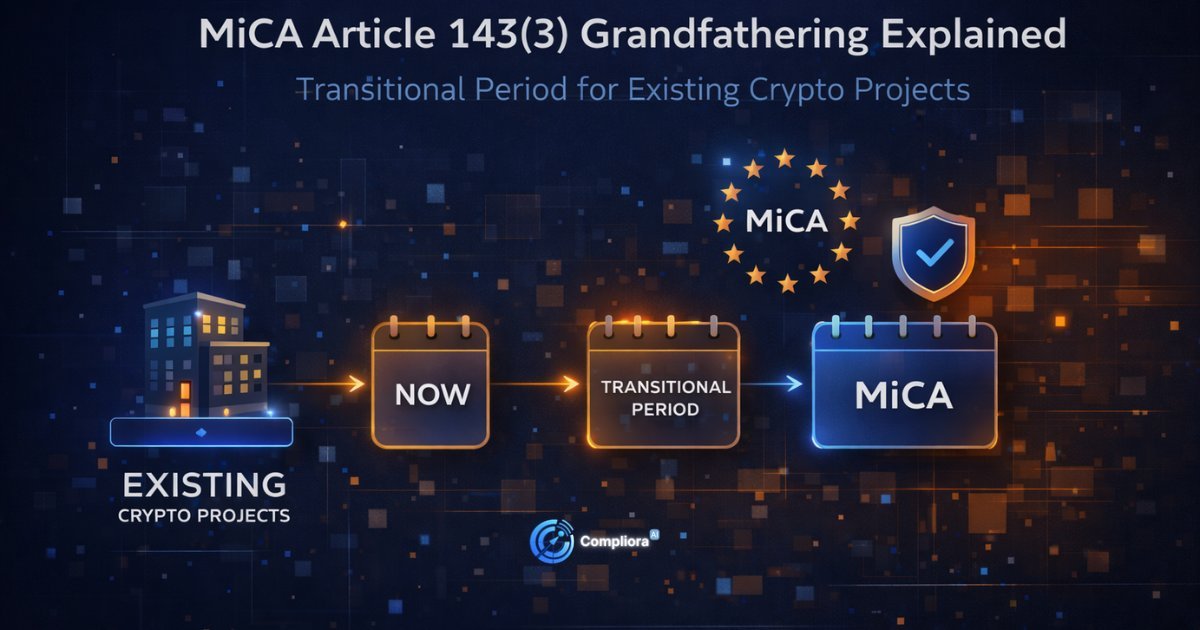
What is Article 143(3) grandfathering?
Grandfathering is a common feature of new financial regulation. When the EU introduces a new licensing regime, it recognises that businesses operating legitimately under the old rules need time to transition. Requiring immediate compliance with a completely new licensing regime on day one would create chaos — existing service providers would be forced offline overnight, and national regulators would be overwhelmed with simultaneous applications.
MiCA's Article 143(3) provides exactly this safety net for crypto-asset service providers:
Crypto-asset service providers that provided their services in accordance with applicable law before 30 December 2024, may continue to do so until 1 July 2026 or until they are granted or refused an authorisation pursuant to Article 63, whichever is sooner.
— Article 143(3), Regulation (EU) 2023/1114 (MiCA)
Read carefully, this provision does three things:
- Creates a grace period for existing CASPs until 1 July 2026
- Makes the grace period conditional on the entity having provided services in accordance with applicable law before 30 December 2024
- Ends the grace period earlier when the entity is granted or refused MiCA CASP authorisation under Article 63
The second subparagraph of Article 143(3) adds an important carve-out: Member States may decide not to apply the transitional regime at all, or to reduce its duration, where they consider that their national regulatory framework applicable before 30 December 2024 was less strict than MiCA itself.
This gives each Member State significant discretion. Some apply the full 18-month period to 1 July 2026. Others have shortened it to as little as 6 months. Where your entity is based or authorised determines how much grandfathering time you actually have.
Who qualifies for Article 143(3) grandfathering — and who doesn't
Grandfathering is a narrow provision. The eligibility criteria are strict.
Who qualifies
- Entities that were providing crypto-asset services before 30 December 2024 — the service provision must predate MiCA's full application date
- Providing services in accordance with applicable law — you must have been operating lawfully under whatever national regime applied to crypto services in your Member State (e.g., BaFin registration in Germany, PSAN in France, VFA in Malta, VASP in Ireland)
- Providing the same services you want to continue — the grandfathering covers the services you were actually providing, not services you wanted to add later
Who does NOT qualify
- New entrants — Entities that did not exist or were not providing crypto services before 30 December 2024 cannot benefit from grandfathering. They must apply for full MiCA CASP authorisation under Article 63 from the start.
- Unlawful operators — Entities that were operating without the required national authorisation, registration, or approval do not benefit from grandfathering. "Applicable law" means the law that actually applied — including any national licensing requirements that were in force.
- Service expansion — If a grandfathered entity wants to add new service categories (e.g., moving from custody into trading platform operation), the new services need full MiCA authorisation, not grandfathering.
- Cross-border expansion — Grandfathering applies only within the Member State where the entity was lawfully operating. An entity grandfathered in France cannot use Article 143(3) to start offering services in Germany without full MiCA authorisation.
Critical: Grandfathered CASPs do not get MiCA passporting rights. Cross-border services require full MiCA authorisation. Many founders assume grandfathering is the same as authorisation — it isn't. Grandfathering just lets you continue what you were already doing, in the country you were already doing it.
Member State timelines — where your grandfathering ends
Each Member State has decided whether and how long to apply the transitional regime. The results differ materially:
| Member State | Grandfathering end date | Notes |
|---|---|---|
| Czech Republic | 1 July 2026 | Full 18-month period |
| Estonia | 1 July 2026 | Full 18-month period |
| France | 1 July 2026 | Full 18-month period; simplified procedure under Art. 143(6) |
| Luxembourg | 1 July 2026 | Full 18-month period |
| Malta | 1 July 2026 | Full 18-month period; simplified procedure adopted |
| Austria | 31 December 2025 | 12-month shortened period |
| Germany | 31 December 2025 | 12-month shortened period; simplified procedure under Art. 143(6) |
| Ireland | 30 December 2025 | 12-month shortened period |
| Italy | 30 December 2025 | 12-month shortened period |
| Spain | 31 December 2025 | 12-month shortened period |
| Netherlands | 30 June 2025 | 6-month shortened period |
| Poland | 30 June 2025 | 6-month period for registered VASPs |
The information above reflects the position published by ESMA and updated by industry trackers as of early 2026. Individual Member State rules are frequently updated and should be verified with the relevant NCA.
Why the differences? Member States whose pre-MiCA national regimes were relatively strict (AML, governance, capital rules comparable to MiCA) generally kept the full grandfathering period. Member States whose pre-MiCA regimes were lighter generally shortened it, reasoning that fully unregulated or lightly regulated service providers shouldn't benefit from 18 months of continued "light touch" treatment.
Simplified authorisation under Article 143(6)
In parallel with Article 143(3) grandfathering, MiCA provides another useful transitional tool under Article 143(6): a simplified authorisation procedure for entities that were already authorised or registered under national crypto-asset regimes before 30 December 2024.
The simplified procedure does not exempt the entity from meeting MiCA's substantive requirements — capital, governance, operational controls all still apply. But it allows the NCA to rely on existing documentation and assessments from the prior national authorisation, reducing duplicate work and accelerating the authorisation process.
Not every Member State has adopted a formal simplified procedure. Among those that have:
- France (AMF) — introduced a simplified procedure for existing PSAN registrants
- Germany (BaFin) — introduced a simplified procedure for entities with existing KWG-based crypto custody authorisation
- Malta (MFSA) — indicated that a simplified procedure will apply to existing VFA agents
- Estonia, Netherlands — no formal simplified procedure, but pragmatic processing for already-known entities
Even where the simplified procedure applies, you typically still need to demonstrate full MiCA compliance. It's faster, not easier.
Grandfathered and navigating MiCA?
Compliora AI helps existing CASPs understand their grandfathering status, identify gaps against MiCA requirements, and plan their authorisation timeline. Get a full assessment in ~10–15 minutes.
Start Assessment →What grandfathered CASPs can and can't do
Grandfathered status creates a specific set of permissions and limitations.
What you CAN do during grandfathering
- Continue existing services in your home Member State — the services you were providing before 30 December 2024, within the scope of your pre-MiCA authorisation, can continue until the grandfathering end date
- Serve existing clients in your home Member State — your client base built under the old regime can continue being serviced
- Apply for MiCA authorisation — in parallel with continuing operations
- Use the simplified procedure if available — in Member States that have adopted it
What you CANNOT do during grandfathering
- Passport services to other Member States — passporting requires MiCA authorisation, not grandfathering. Grandfathered entities can serve only their home Member State.
- Add new services — expanding into new CASP service categories requires either a new national authorisation (where still possible) or full MiCA authorisation for the new services
- Change service scope materially — significant changes to service offerings may trigger the need for MiCA authorisation before implementation
- Avoid MiCA substantive requirements — some MiCA requirements apply during grandfathering. For example, market abuse rules in Title VI apply to all crypto-asset services from 30 December 2024, regardless of grandfathering status for authorisation purposes.
Common mistakes about grandfathering
"Grandfathering means we don't need to worry about MiCA"
No. Grandfathering gives you a runway to comply with MiCA — not an exemption from it. Every grandfathered CASP needs a plan to either apply for MiCA authorisation before the grandfathering deadline, or wind down operations. Doing nothing means losing the ability to operate legally on 1 July 2026 (or earlier in some Member States).
"We can start new services under grandfathering"
No. Grandfathering covers the services you were actually providing before 30 December 2024 under applicable law. New services require either a new national authorisation (if your Member State still allows it during the transition) or full MiCA authorisation. This is one of the most common misunderstandings.
"We can passport our grandfathered status"
No. Passporting is a right that attaches to MiCA authorisation, not to grandfathered status. A French PSAN registrant relying on Article 143(3) cannot use that status to offer services in Germany. To access the full EU single market, you need MiCA authorisation.
"We can just wait until 1 July 2026 and then apply"
This is a very dangerous assumption. The statutory MiCA authorisation timeline (25 working days completeness review + 40 working days assessment) is the minimum. In practice, NCAs are experiencing heavy application loads as the grandfathering deadlines approach, and realistic end-to-end timelines are 6-12 months. Applying too late means a gap between grandfathering ending and authorisation being granted — a period during which you cannot legally operate.
"Our AML registration counts as lawful operation"
Depends on the Member State. In some countries, AML-only registration (for example, the pre-MiCA Irish VASP regime under the Criminal Justice Act) was the full "applicable law" for crypto services. In others, additional authorisation was required. You need to verify that your pre-MiCA regulatory status actually covered the services you provided under applicable law, not just AML compliance.
Strategic implications and timelines
For an existing CASP operating under grandfathering, the strategic question is simple but critical: when do you apply for MiCA authorisation?
The authorisation pipeline
Preparing a MiCA CASP application typically takes 3-6 months of focused work. The application package includes programme of operations, governance documentation, fit-and-proper submissions, AML/CFT manuals, ICT documentation, risk management framework, and a detailed business plan. See our CASP licence requirements guide for full detail.
Once submitted, the NCA has 25 working days to assess completeness under Article 63(2), followed by 40 working days to adopt a decision under Article 63(9). In practice, most authorisations are taking 6-12 months from submission to final decision due to information requests, interviews, and iterative refinement.
Working backwards from the deadline
If your grandfathering ends on 1 July 2026, a realistic reverse-engineering gives:
- July 2026 — Grandfathering ends (or earlier in your Member State)
- January 2026 — Application ideally submitted by this date to have a reasonable chance of authorisation before grandfathering ends
- July 2025 — Documentation work ideally starting now
Reading this in March 2026, the reality is that most grandfathered CASPs in 18-month jurisdictions should have applications already submitted. Those still in preparation face tight timelines and potential operational gaps.
The queue problem: Every grandfathered CASP in the EU is approaching the same deadline. National competent authorities are experiencing unprecedented application volumes. Applications submitted in the last 3-6 months of grandfathering periods face extended processing times simply because the authority's capacity is overloaded.
Action plan if you're relying on grandfathering
If your business is currently operating under Article 143(3) grandfathering, here's a practical checklist:
- Confirm your grandfathering status. Verify the exact date your national grandfathering period ends. Check with your NCA or specialist counsel. Assume the earlier of (a) the date in your Member State and (b) when your MiCA application is decided.
- Map your current services against MiCA categories. Under which of the ten CASP service categories in
Article 3(1)(16)do your current activities fall? Which are grandfathered and which require new authorisation? - Identify gaps against MiCA requirements. Compare your current governance, capital, AML, client asset rules, and operational setup against MiCA Title V obligations. Identify specific gaps.
- Prepare the MiCA application. Documentation, capital evidence, governance framework, AML manual, technology description, business plan. Engage specialist legal counsel early.
- Submit the application well before deadline. Aim for submission at least 6 months before grandfathering ends. Earlier if possible.
- Maintain compliance during review. Many MiCA obligations apply from 30 December 2024 regardless of grandfathering. Market abuse rules, AML, and conduct standards should already be aligned.
- Plan a contingency if authorisation is delayed. Have an operational plan for what happens if your grandfathering ends before authorisation is granted — including potential temporary service suspension or wind-down.
- Monitor NCA communications. Your regulator may issue additional guidance, request information, or update timelines. Respond promptly.
The transition from national regimes to MiCA is the single biggest regulatory project most EU crypto-asset service providers will undertake. Getting it right protects your business; getting it wrong means losing the ability to operate in the EU.
Assess your MiCA readiness in ~10–15 minutes
Compliora AI runs your existing operations through MiCA Title V requirements, identifies gaps, and produces a prioritised roadmap. Professional report with article-level citations — ideal for briefing internal teams and external counsel.
Start Assessment →